Thursday, September 5, 2013

Lessons of the Hummingbird


I've been dedicating posts to good friends lately and today is no different. Before we get to our honored animal, I want to tell you a little about Mallory and myself: I met Mallory as the girlfriend of a high school friend. She and I got along well, but weren't especially close. Then I had my accident... All my friends rallied around me, but they kept wondering when I would go back to the old Cassie. I didn't know how to explain the "old me" died that day. I never had to explain that to Mallory - she just plain got it - and from that day on we became best friends. We share secrets to life most of the world has yet to realize. Mainly that life is hard and doesn't owe you anything. That doesn't mean you give up, it means you fight harder for what you want. Bad things happen to good people every day and it isn't a punishment; it's just life. We both struggle with fitting in in a conventional world because we're both far from conventional. I'm a nature loving, science nerd who also loves the Chargers despite their dismal record. (Antonio Gates, if you read this blog, hit me up.) She is a writer first and foremost (check out her blog Mal Adjusted here), a 3rd degree black belt, and most easily described as the ultimate firecracker. Mallory also loves hummingbirds, she and I both being believers in spirit animals and animals as signs as to what life may bring us.

So before I go into the hard science of hummingbirds, first I want to explore the spiritual significance and symbolism of them. In the Andes of South America, the hummingbird is a symbol of resurrection. It seems to die on cold nights, but comes back to life again at sunrise. Hummingbirds are seen as messengers that open the heart. The fluttering wings of the hummingbird also move in the pattern of an infinity symbol - further solidifying their symbolism of eternity and cyclicality. Hummingbirds remind us to re-examine how we spend our energy. They are superiorly efficient creatures and they serve as a reminder to be more like them.

Now to explain some of the cool qualities hummingbirds have with science. Hummingbirds are the only bird that can fly backwards. They do so by rotating their wings in a circular pattern instead of up and down. This is also why the hummingbird must beat its wings so quickly and are seemingly tireless. For other birds the down stroke requires very little energy where the upstroke requires great effort. The Hummingbird doesn't get a break, spending huge amounts of energy anytime it is flying. This translate to Mallory and my life , perfectly. We are both firm believers of doing things in life our way instead of the conventional or often easy way. To compensate for these huge energy expenditures the hummingbird consumes more calories than any other bird. If you have seen Mallory and I eat dinner you can see how this is also very fitting for us, we can put down food like no other. If the hummingbird sleeps too long it can literally starve to death. The Hummingbird also has the largest heart compared to its body size of any bird. If you know Mallory you know this is the best comparison of all. This girl loves like no other. Hope you all enjoyed learning about my best friend and another amazing creature.

That's all for now,
Cass

Wednesday, August 7, 2013

Prepare for a Cute Attack


Again, I must apologize for the extended time between blog posts. I haven't abandoned my love for animals and science. I have been busy working far too much, saving plants, and riding horses somewhere in the middle of it all. For my blog posts I often ask people for suggestions on what animals to write on, well my good friend Armon voted that everyone needs to know more about the adorable Red Panda. To see just how adorable click on the link below for a cute overload: take me to adorable baby red pandas...

Red Pandas are not related to Giant Pandas, sorry I know it is truly devastating, but I don't think one genus could survive that much cuteness... Instead they are more closely related to raccoons, skunks, and weasels. They are the only living species of the genus Ailurus. Classification of the Red Panda has been a heated issue, initially they were assigned to the raccoon family, then to bears, finally scientists decided (or were brainwashed by the Red Pandas flicking their fluffy tails) to give Red Pandas their very own family classification. Their nearest relative was Parailurus who lived 3-4 million years ago and died out in the last Ice Age, thus proving Red Pandas are either tougher or luckier than first believed.


 Red Pandas are arboreal mammals, meaning they live their life in trees. Their claws are semi retractable, those combined with a special false thumb allows them to descend trees headfirst. They claw with their front legs and rotate their ankles to grasp either side of the tree, making even the most skilled pole dancers jealous. They are omnivores and mainly eat bamboo, but also enjoy eating eggs, birds, and insects (don't let your guard down)... They live in the eastern Himalayas of China.

When threatened Red Pandas will try to flee up a tree or rock, however when trapped they will stand up on their hind legs to look bigger (or more adorable) and use their small but fierce front claws to hopefully deter their enemy (or have cute jazz hands). Red Pandas are solitary creatures except for mating season when like humans all morals are compromised for the perpetuation of the species.

I promise I will try and get back to more regular posts at least once a month in the future. Love you all,
Cass
Jazz Hands

Monday, April 8, 2013

Honey Badger is Kicking Ass and Taking Names

Often I ask for my friends animals to write about. This week I asked one of my best friends Elena and she picked one of the toughest critters alive, the Honey Badger. How is a seemingly cute weasel-like animal tough as nails? In case you haven't seen one of the funniest video's I have ever seen, please watch below first (note this video contains lots of adult language)

Elena and I have been friends for over 15 years. I truly believe she is one of my soul mates on this earth. Right now we're both going through a very rough patch in life. At the moment we're both channeling our inner Honey Badgers. I believe we choose all aspects of our life, but it may not always be in the conscious part of our brain. If we choose everything that happens to us in life, then why do we have so many bad things happen? I see it as our greater subconscious being can see where we want to be, but also knows that our conscious reptilian brain will never go there willingly. Humans brains are wired to keep a routine and not take risks. We have lessons to learn, and often they're not lessons we would experience willingly. So our subconscious brain will create a scenario that is less than desirable to our conscious brain. I've spoken about my accident in the past and often get asked if I could have a re-do would I take it? Not a chance. I took many things away from me that day, but four stick out in my brain. 1. I know what true friendship is. I had several friends put their lives on the line to save mine. 2. I know how strong I am. Not much scares me now days. 3. I don't sweat the small stuff often (and it is true, everything is small stuff).
Four amazing gifts that I would never have gotten if I didn't go through some serious torture. So how does this all tie back to the Honey Badger? Well, when you're going through those moments in life where your subconscious is teaching you a hell of a lesson, you get to channel your inner Honey Badger. 
  • Up against events in life that seem impossible? Honey Badgers weigh about 30 lbs and have taken down foes far superior in size and strength. They routinely hunt cobras and small crocodiles. A honey badger will even take away gazelles from lion packs.
  • Need tougher skin? Honey Badgers routinely ransack African bee hives (these are the crazy killer bees everyone warns you about). Their skin is very thick and can resist the stings. Their skin is also what allows them to repel snake bites.
  • Can't figure something out in life? Honey Badgers are one of the few animals that can use tools. A honey badger was filmed rolling a log to a cave in order to reach its prey.
So if life has you down,channel your inner Honey Badger and start kicking ass and taking names.
Cass


Thursday, January 17, 2013

Plants 101

When people learn one I'm a botanist (i.e. super plant person) the next line out of their mouth is I can't grow plants or I kill plants. There's a reason that people think they have a perpetual black thumb, no one ever set you up for success. If in life no one ever taught you the correct way, would you expect to succeed? Of course not. Yet the majority of people seem to think growing any plant requires a mystical green thumb that you can only be born with, otherwise you are doomed to be the grim reaper of plants. I promise there is hope for anybody!

a variety of succulents

Of the plant killer group, people follow two thought processes on what it actually takes to grow plants. Route 1 is it only takes any random dirt and some water, then they're dumbfounded when their plant dies.  Route 2 believes that plants are impossibly complex and don't even attempt to grow them. Both groups are going about this the wrong way. To start I suggest everyone who has never grown a plant practice on something very hard to kill, succulents! The beauty of most succulents is they take very little maintenance and can tolerate lots of abuse. You can literally forget to water your succulent for weeks and it will be just fine, promise.
 
Succulents on my deck
 To start from the basics, make your own soil. Almost all of the commercial potting mixes are laced with hormones and additives which will initially make your plant grow quickly. The downside is after awhile your plant will be sitting in mush and have a poorly developed root system. I mix my very own soil and it tends to be slightly cheaper if you buy in bulk. First get a bag of peat moss and a bag of perlite. For succulents mix them 60% perlite, 40% peat moss. Take your succulent out of the original pot it came in and put in a new pot double what your plant came in. Make sure you pack it in firmly and fill soil to the top. There you have it! By having a custom soil mix you ensure your plant will hold the ideal amount of water. Succulents are drought tolerant and do best with minimal watering. So if you don't water it for a week, no problem, if you accidentally water it too much, your custom soil mix ensures the water will drain out the bottom. Keep your succulent outside in a nice sunny spot. They can handle extreme heat and minimally freezing temperatures.

Mixing your own soil for each plant is your safety net. Perlite adds drainage to a plant, peat holds moisture in. If you venture outside the world of succulents you just figure out where your plant originally came from and how much water it prefers, then adjust your peat moss to perlite ratio accordingly. If I'm unsure what amount of water a plant would like I tend to start it in a 50/50 ratio of peat moss to perlite. It the plant looks bogged down or soggy I will replant with more perlite, if it constantly looks thirsty, add more peat moss.

Some general plant tips:
  • Watch out for plants getting root bound. This is when the roots start coming out of the bottom of your pot, this means your plant is ready for a larger pot and new soil.
  • Keep an eye out for sun burnt leaves, your plant will tell you if it is getting too much sun.
  • If your plant turns pale and albino, that's a sign it needs more sun.
  • Use a basic fertilizer once a month for indoor plants, they use up the nutrients in their soil quicker than outdoor plants. Be careful not to apply fertilizer on the stems of plants.
  • Plants like fresh soil, if your soil looks crusty means the nutrition has been depleted. I accidentally dwarfed several plants by denying them fresh soil for over a year. After changing out their soil, poof! They doubled in size.
  • Plants enjoy a hair cut, if they start looking tired trim them up, it will stimulate roots to grow, and get rid of any dead limbs.
  • Google! Look up your plant and see where it likes to live, how much water it desires, how others grow them. If your plant looks sickly, google its symptoms. There is a huge very supportive plant community out there.
  • Plants will die, its a part of life just like everything else. I will guarantee every plant expert has had plants die on them.

Remember plants are resilient organisms and want to thrive. I have faith in you all. You can ask me any plant questions if you get stuck.
Good luck,
Cass 


Thursday, January 10, 2013

Why I Ride


The Early Years

I had a post all ready to go about first time plant growers, but last night while riding my horses I had another post fighting in me to be written. I was walking around the ranch on my red horse Finally and just had a truly appreciative moment. Here I was alone in utter peace. There was a haze that had settled around the ranch, barely lite with sporadic lamp posts, and yet when looking straight up the sky was clear with sparkling stars that you just don't see the same in the city. It got me thinking about why I have horses. (please note at any time in this post feel free to add dog or cat or any other animal that gives you these feelings) People are shocked when they learn my horses cost me more than my rent, car, food, all other extra bills combined. Yet, each month I write their feed and board check without a second thought. I have eaten Top Ramen and Mac N Cheese for a month straight, while my horse ate every vet recommended supplement. My shoes have holes in them, yet my horse has a brand new shiny pair on right now. One horse even killed me. A horse I didn't know, had a break with reality and pinned me between a truck and kicked my face in. But that same day, my own horse stood between that horse and took kicks meant for me, then refused to leave my body. If I had to choose between reliving that day again or a life without horses, I'd happily die all over. My horses are priceless.


My two grey ponies, Phoenix and Max

Animals and especially horses are a persons mirror. They can sense whatever is on your mind and spit it right back at you good or bad. To me that's a gift. So many of us walk around this world with a facade on, thinking we have the world fooled. But that horse will sense it in a second. By being my mirror, my horses call attention emotions that I've been stuffing (I'm a girl we're fabulous at stuffing emotions), by becoming aware I've been neurotic I can begin to process and resolve it. My horse is the worlds best and most affordable therapist. I remember being a 10 year old girl and going up to my grey pony Phoenix and pouring my heart out. She walked up to me and just put her nose on my tear streaked cheek and sat there. I threw my arms around her and sobbed. That pony saved me from so much strife. Even now days when times get tough I go to my horse. My friend committed suicide recently and I had no idea how to process it, so I hopped on Finally bareback with just a halter and bared my soul again. He just cruised me around the ranch while I cried over a life too short. After I got off a hour later, nothing had changed in reality but I felt like I could at least deal.


Manhattan

My horses have taught me pride and humility all in one. I took Manny my thoroughbred from abused and nothing but skin and bones to the picture of health and fitness. We were a team that would jump anything. During one jumper show the organizers set up a jump that was meant to be terrify and almost un-jumpable. A standard picnic table complete with benches, decorated to the max. The table itself was narrow yet impossibly wide, and the table cloth was loosely attached so it flapped. No horse would go within 10 feet of the thing, but I took my beast of a thoroughbred, galloped up to it and soared right over. People stood there shaking their heads in disbelief. How could one pair have so little fear and trust in each other? On the other hand, I can remember riding a tiny pony named Squirt for one of my students who had just gotten bucked off for the second time. I was going to show this pony who was boss... I cantered a few laps around when the little guy stuck his nose to the ground and bucked, I flipped head over heels landing in a giant heap still holding the reins. I wouldn't let go and the little brat tried to take off and drag my fat ass, didn't work out so well for him. I go back on and managed to get him going decent. The little kid and her parents asked if I was hurt, I replied, "only my pride is broken". It's that instance where you realize the smallest pony can humble any rider.


Manhattan (the once starved horse)

My horses teach me how to be a better human being. I have had to re cooperate horses starved and beaten an inch from life. This horse has no reason to trust me. All its life humans have only hurt it, yet its spirit still wants love. It will allow me to show it not all humans are bad. It makes me think somewhere out there is that person for my heart, yes it has been trampled, beaten, starved, but somewhere out there is someone who will gently nurse it back to health, but I have to trust them to do it. Horses have taught me how to love without fear, because they love me unconditionally. They have never let me down.

Hug your animal extra today and tell them how much you appreciate them,
Cass

Love


Thursday, December 13, 2012

Do Flashy Monogamists Exist?

Taking from last weeks post I'm going to mix in a little more of my real life along with your animal facts. Lately I have gone on a quest to bring out a little more of my inner femininity. Growing up I was always more of a tomboy, I loved sports (still do), had an easy time hanging with the boys, I still dislike drama filled girls, all this lead to me suppressing my inner girl. Anyone who knows me realize how laughable this ultimately is. I'm blessed with a natural Scarlett Johansen, Kim Kardashian body. I'm pretty sure my skeleton has some hips on it and lets just say I definitely won't be needing implants anytime soon. No matter how much I have tried to discourage my inner girl, every time I stared in the mirror I would get a constant reminder of looking as feminine as one can be. Instead of fighting it, I have decided to embrace it and discovered I love being a girl. It is really nice to have a drink bought for you, dress up in high heels, do crazy things with my hair, being a girl is basically free license to experiment with whatever look I want. Being a scientist means experimentation and new discoveries is pretty much my drug of choice.

My aptitude towards tomboy tendencies isn't very uncommon in the animal kingdom. The males of most species are typically the bright and colorful ones. They need bright and colorful plumage to attract the opposite sex during mating season. The females need dull muted coloring to blend in with their environment, staying hidden to protect their young. Take peacocks for example, the males have giant feathers in a rainbow of colors, where their peahen counter parts are left with muddy brown minuscule feathers. There are some examples of colorful female animals, but they appear in polyandrous species (where the female mates with multiple males) seen in: parrots, hummingbirds, angelfish and butterfly fish. Often in these cases the males are plainer in coloring and left with doing the child rearing. It makes morphological sense for the females to be brightly colored so they can attract multiple mates.

Monogamy in the animal kingdom is actually quite rare, this excuse has been a favorite of playboys like Hugh Hefner as a reason to have a plethora of girlfriends. When I picture my ideal reality I'm not with multiple partners but one special one. But are there are monogamous brightly colored female animals? Is it even remotely in my DNA to be monogamous? The answer came in one of my favorite animals,  the mimic poison frog, R. imitator. The current belief of monogamy started by Devra Kleiman is that it evolved as a life history strategy when biparental care becomes critical to offspring survival. In this situation, both parents may experience higher reproductive success by investing in their mutual offspring instead of seeking extra pair reproductive opportunities [DOI: 10.1086/409721]. The female will lay her eggs in water, then the male will transport them to trophic level plants with pools of water in them away from hungry predators. The female will then lay non-fertile eggs in the small pools to feed the growing tadpoles. Other poison dart frog species are not monogamous and their offspring have lower survival rates.


Rainbow Bright for Halloween
 So channel your inner mimic poison frog, be colorful, flashy, and different, all the while searching for that perfect partner to raise your tadpoles with.

Happy hunting,
Cass

Thursday, November 1, 2012

Hearts of an Earthworm


Got to kiss a lot of frogs to find your prince
 I know I haven't written awhile yet again, lots of changes going on in my life. Again I've been struggling with inspiration, unfortunately I received inspiration in a difficult way this month. My heart has experienced some big challenges. A good friend choose to take her own life. That alone was a lot, especially because she was very close with of one of my best friends, and watching her struggle with continuing on with her own life without our friend just plain hurts. I have had my own experience with death, and it doesn't bother me as much as others.  I've seen the other side and I know my friend is completely at peace learning lessons on the other side and sharing her experiences from her time on earth. That said, it doesn't take away the pain and hurt from the people she left on earth.

I've also been struggling with finding a relationship that was a good fit for myself and in the process got my heart ssquished yet again. Finding dates has never been the issue. I'm outgoing I like to chat with all sorts of people, I like to think I'm cute, I have curves that are kicking like J-Lo and Beyonce. My problem is that transition from friendship and casual dating to monogamous relationship. Recently I've spent two months with a guy and so many things clicked. The main issue was general consideration, as in not flaking on me or just realizing hey maybe Cass would like to join my friends and I out. I talked it out with him and he told me something was missing, I was smart, funny, beautiful, but something he couldn't explain wasn't there. In that sentence my little heart broke. I said I respected that and you don't want to force things, I wished him well, I did the adult thing.


what my inner Earthworm looks like
 I've had my heart broken before. I can only say I've ever followed my heart 100% once. I was 22 and in the midst of my first love, God I thought he was amazing and just so in shock he loved me back as much as I loved him. We took trips together, rode our horses, loved each others friends, it seemed so fairytale. We moved in after a few months, but I realized that in my head over heels love phase I ignored some giant red flags. It became a daily struggle, my heart and my brain battling on what to do... Eventually my brain won out, I moved out and experienced my first giant heartbreak. So here I find myself with a much smaller heartbreak, it didn't shatter my heart like my first love, but it definitely feels as though someone kicked me in the chest (and you all know I know what a swift kick feels like). So I ask myself what do I do? Keep on trying and look for love again, even better I'm going to channel my inner earthworm.

You knew eventually I would get around to the animal facts. But I'm sure you're asking, what in the world do Earthworms have to do with heartache? Well Earthworms happen to have five hearts, and what better time than a break-up to swap out that broken heart for a brand new one! Earthworms have five pairs of simple hearts that pump blood throughout the body. They have no lungs. That feeling you get post break-up where you cant breath? No problem! Instead the blood flowing close to the worm's surface absorbs oxygen and releases carbon dioxide directly through the moist skin (called the cuticle). The uncontrollable crying you do, again no problem! Instead of a nose, ears, and eyes, Earthworms have a nervous system throughout their bodies that controls actions in response to environmental stimuli, such as vibrations, heat, cold, moisture, light, and the presence of other worms. When you can't get your brain to shut off and stop thinking about your ex? Earthworms have no brain!

In my eyes, kinda what this blog is about, the Earthworm is the perfect break-up animal to channel. Once your broken heart has recovered allow it to join up with your others and you can let your inner Earthworm lie dormant for awhile. It does get better everyone, and life does go on. I like to remind myself that there are lessons learned from every event in life, the heartbreaks really do just plain suck. Without the rain we would never truly appreciate the sun... Now onto my next goal find a guy I like half as much as my horse! Side note if you are available gentlemen who reads this blog and have several qualities as my adorable horse, hit me up!
Cass

Thursday, September 13, 2012

Leaping Lemurs

I was having some difficulty coming up with this weeks post... I'm going to attribute it to fun overload from actually having some free tiem in my life and taking full advantage of it. I started thinking what unusual animal to write about when Lemurs popped into my head. Specifically the one Ring Tail Lemur from Madagascar who is absolutely hilarious. So, in honor of King Julian, here is the Lemur post.

Lemurs only inhabit Madagascar, a small island off the coast of Africa. It is believed they arrived to Madagascar 65 million years ago on rafts of floating vegetables. Madagascar was formed during the break-up of Gondwanaland, 135 million years ago. 90% of the species found on Madagascar are endemic, meaning they can only be found on the island. As of 2012, 103 species of Lemur have been identified. 

Lemurs are Strepsirrhini primates, this is not to be confused with chimps, monkeys, and humans which are all Anthriod primates. Strepsirrhini primates share many of the same morphological traits as Anthriod, including divergent digits and nails instead of claws.  One main difference is their brain to body ratio is significantly smaller. All Strepsirrhini primates also have a rhinarium (wet nose), a pheromone detecting vomeronasal organ, lack of thin bone behind the eye (post orbital closure), orbits that do not fully face forward, and un-fused lower jaw bones. It is likely the original Lemur ancestor was a Loris another Strepsirrhi primate.

Lemurs vary greatly in size, the smallest is the Mouse Lemur at 1.1 oz, and the largest at 20 lb for the Indri. Recently extinct species of Lemur could get to the size of a male gorilla. Lemurs do not have prehensile tails, that is a trait only found in new world monkeys. Each subspecies of Lemur has evolved specific traits to help give it a competitive edge. Most Lemurs have specialized teeth, the Aye-Aye has incisors that continuously grow to allow it to gnaw on seeds and wood. Other Lemurs have a tooth comb that is used for grooming purposes. Lemurs have extremely fast tooth development, often far faster than the rest of their body.

Lately lemurs of all kinds have been threatened due to the encroachment of humans on Madagascar. Animals that are isolated on islands have a history of doing poorly and often wiped out to extinction when a new predator (especially humans) is introduced. New Zealand's Elephant Bird was wiped out to extinction by humans, and now its much smaller relative the Kiwi is in danger from similar problems. Lemurs face the large human created issue of habitat destruction. The wide variety of Lemurs is do to extreme specialization. Each Lemur species is highly adapted to a very specific ecological niche, with some that are tree dwelling, some only live in water reeds, in places that one would never expect. Even a small portion of habitat being eliminated can cause a Lemur's entire ecological system to be extinguished. Humans also hunt Lemurs sometimes for food but more often as totems or even to ward off villagers from different tribes. Lemurs are a great example of an animal that is extremely sensitive and unable to adapt to habitat destruction even in the smallest of forms.

That's it for now,
Cass

Wednesday, August 29, 2012

Holy Mola Mola


Size Comparison
 I often take requests on which animals people want me to write about.  Recently my friend Bernie asked me to write about the Mola Mola.  Interestingly enough this fish happens to be a great part of one of my favorite topics, how animals deal with environmental changes. It is a rare week where you don't hear someone talking about global warming and climate change. I'm not going to discuss whether i believe it is human caused or part of a natural earthly rhythm, well I won't discuss it today. But the truth of the matter is the worlds oceans are showing some of the effects from our changing climate. First some facts about the Mola Mola. In Latin, Mola means millstone which the fish resembles due to its flat shape and grey color. Where its English name Sunfish refers to its basking behavior.
Exhibiting Basking Behavior

The Ocean Sunfish otherwise known as the Mola Mola is the largest bony fish in the world. Fish come in several types but the main two are bony and cartilage. Cartilage fish include sharks. Mola Mola's can weigh up to 2,000 lbs while being as tall as it is wide. They are rather flat in width and exhibit a very unusual basking or sunning behavior.  They will go to the surface of the water and swim on their side. It is believed they swim along the surface on to prep for going into colder deeper water. The Mola Mola is truly a sun-loving fish and enjoys warmer water, mainly tropical and temperate waters. The Mola Mola is able to reach such a large size due to some odd features. Its spinal column contains fewer vertebrae and is shorter in relation than any other fish. The skeleton also contains vast amounts of cartilaginous tissue. Cartilage is lighter than bone and can allow for the fish to grow to sizes larger than any other bony fish. 
I happen to live in the beautiful city of San Diego, and recently there was a sighting of one of this fish nearby. This is highly unusual because we have rather cold water.  It could be an indicator of our ever warming oceans. Jellyfish have blossomed to larger numbers than ever. Jellyfish thrive in warmer water. This has encouraged animals who prey on jellyfish to travel with them. Some of the main predators of jellyfish are sea turtles and the Mola Mola. Warming waters can be beneficial to some creatures but extremely harmful to others. Many fish can migrate and adjust their patterns to a more ideal water temperature.  But what happens to coral reefs or kelp beds?  Both highly specialized environments that don't have the option to pack up and leave. I love to point out animals that are bioindicators.  One of my first posts in this blog was about frogs as bioindicators. I wouldn't consider the Mola Mola a bioindicator (there's just too few of them in the world), but their main food source jellyfish are.

Mola Mola's must consume vast quantities of jellyfish to maintain their considerable bulk.  A jelly fish has very low nutritional value. This also may be one of the reasons the Mola Mola are so temperature sensitive, to maintain such great size on food of poor nutrition is very difficult. Animals trade off abilities in many ways, the Mola Mola has opted for large size, but they have poor temperature regulation. Aquariums have had a hard time keeping these giant fish in captivity. They require large space and often injure themselves bumping into sides of tanks. These fish haven't been studied as indepthly as others. I hope that fish as unique as the Mola Mola have a future ion our oceans. Their future is an uncertain one, but there's always hope.

That's it for now,
Cass

Tuesday, August 21, 2012

Popcorn the Super Skink


Damn he's a sexy lizard
 So recently the urge to add a new addition to my herd overwhelmed me.  For those who know me I already have 3 horses, a cat, giant bunny, toad, fish, and now (drum roll please) a Skink!  His name is Popcorn and he is a Berber (not like Justin Bieber) or Schneider's Skink.  As you can see he is absolutely adorable and very friendly (please take a moment to adore his cute face). 

Skinks are lizards and not the missing link between snakes and lizards. The do look very snake-like with their long body and short legs. Skinks can range in size from 3 in to 32 inches, though the Berber Skink (Popcorn) will be about 15 inches including tail. Skinks live in a variety of habitats, to determine where your skink lives simply look at its toes. The longer the digits, the more arboreal (tree dwelling) the species is likely to be. This is reffered to as the Scincidae Ecological Niche Index, a ratio based on anterior foot length at the junction of the ulna/radius-carpal bones to the longest digit divided by the snout to vent length (nose to butt).  Popcorn happens to have medium digits, Berber skinks are largely terrestial. Berber Skinks are originally from North Africa and West Asia.  They come in a variety of colors including gray, red, brwon, sand, and even in Popcorn's color, bright yellow with orange spots.

Popcorn's favorite perch
Skinks enjoy a wide variety in their diet, some are vegetarian, most are insectivores, and a few eat meat.  Berber Skinks happen to be mostly insectivores, Popcorn's favorite food is a fat juicy cricket.  Eventually if he grows large enough he could a eat pinky mouse (though I tend to not like feeding or watching mammals die so he will have to stick to fat crickets).  Skinks are generally mellow and tame, as my friends have discovered Popcorn is very cuddly. He loves to hang out on your shoulder and crawl up to your head and scope things out. As far as defenses, well Skinks don't have many. Teeth are non-existent, and they're not very aggressive, instead they take the duck and cover approach burrowing under sand to hide. 

Hope you enjoy the pictures of Popcorn, what are some of the members of your herd?
Thanks for reading,
Cass


Thug life


Thursday, August 9, 2012

If I Were an Alligator

Today's post is going to edge along the humorous side more than informational . . . As little kids, we're often asked "If you were an animal, what kind of animal would you what to be?  For years I thought of myself as all these exotic animals like tiger or okapi, but the truth is I'm a total alligator.

Lets start with the physical similarities:

The American Alligator has a thick body and a broad, powerful tail.  Their tail is used to propel them quickly through the water, and also as a defensive weapon. I happen to be gifted with a larger, um . . . Well, I have a big butt. This gives me a great center of gravity, and if a person happens to disturb me I have a broad, powerful booty bump that has been known to send people flying. Alligators also have extremely strong jaws which works like a vice. The biting force of the alligator is enormous, packing enough power to smash a turtle's shell or through bone ; it's designed to grip rather than chew, and thanks to an accident in 2010 I happen to have titanium jaws. Similarly I have a much easier time biting into food than chewing it. 

Onto the Aligators behaviors! Alligator's are one of the few reptiles who are maternal and watch after their young. They guard their nests and will carry the baby alligators around in their mouth. While I do not have any human young, I am the proud parent of many furry babies. Everyone knows I love my horses, cat, lizard, toad, bunny, etc., more than anything. I have a protective nature in general towards my friends in family.


Sunbathing
Alligators live in swampy marshes and prey on a variety of aquatic foods. Younger Alligators eat mostly fish, while mature alligators will occasionally go onto land for food, but still maintain a mainly aquatic diet. The nutria (a large aquatic rodent) is an invasive species which has become a new prey source for large alligators.  My favorite food is sushi and sashimi, I love the taste of raw fish.  I also live in San Diego and love the water. Alligators will often bask in the sun to regulate their body temperature. I have also been caught sun bathing on more than one occasion.


About to prey on some lobster...
Once an Alligator has captured prey, if not already in the water they will drag it in, then proceed to "death roll." They spin at high speeds under water while holding onto the prey, effectively breaking it's neck or drowning it. I have my own version of the death roll. As I have been told by numerous ex-boyfriends, while sleeping I will grab the sheet or blanket then proceed to roll, wrapping it around myself and stealing it from my unsuspecting victim. If one tries to steal my blanket back I become highly aggressive, refuse to relinquish my prize. And I wonder why I'm single . . .

The similarities between alligators and myself can go on and on. We all have the animals we would like to be, but at the end of the day, I'm just an alligator. That's it for now,

Cass

Thursday, July 5, 2012

Holy Horny Toad

Lately I have run into another period of writers block.  Finally I decided I would just pick another of my favorite animals and go from there, so today I give you the The Horny Toad!  The Horny Toad is actually not a toad but a lizard.  It does have a rounded body and stubby tail giving it a toad-like appearance.  The spines along the Horned Lizards back and sides are modified scales, but the horns on its head are true horns.  Horns have a bony core, where as scales are just modified epithelial cells.  Their color varies from red-brown to grey depending on their habitat. 

They have several defenses against predators.  They blend in extremely well with the scrubby brush they inhabit.  Their first defense is to stand very still.  If detected they will puff up to prevent smaller prey, like birds from swallowing them.  They can raise the scales around their head and neck to make picking them up by their neck more difficult.  Their last line of defense is their most unique, they can squirt blood out of the corner of their eyes.  They do this by restricting blood flow leaving their large head.  This ruptures the small blood vessels in the corner of their eye squirting a stream of blood.  The blood also tastes foul to canine and feline predators. 

A Horned Lizard's diet consists mainly of harvester ants but they are not opposed to eating other insects like grasshoppers and spiders.  The biggest threat to Horned Lizards is destruction of habitat and eradication of ants (their main food source).  Pesticides have become so common that it is wiping out entire species of insects.  It is very sad that destruction of habitat and food source is the prevalent theme for more species disappearing. 

That's it for now,
Cass

Thursday, May 24, 2012

More Than a Leaf

Many new and exciting things have been happening in my life, currently the very best one is I have been given an opportunity to study and learn from an amazing person all about plants!  I have only been up to the ranch twice but I have learned so much and feel truly inspired.  So in honor of the wonderful world of plants I want to write about a subject I taught about in my good friend Gilly's 4th grade class, leaves!
I went to Gilly's class to discuss biomimicry and more importantly taking a closer look at the world.  I finished my talk by giving every student in the class a piece of wheat grass and asking why they thought it was designed the way it was.  They had some great and inventive answers, just a small reinder about how we loose the power of imagination and thinking outside the box as we age.  But back to my topic, leaves are a great example of how form follows function.

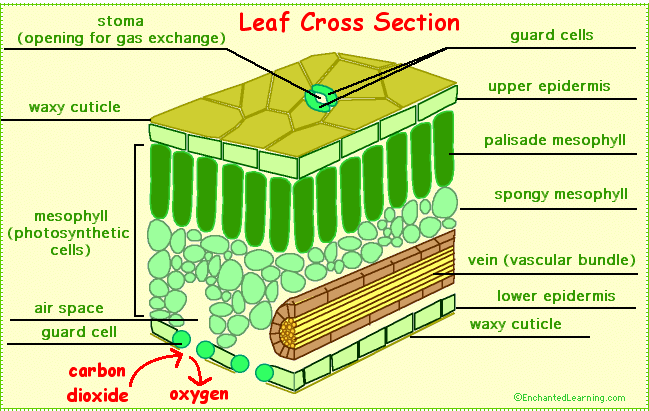
A plants leaves serve the very important task of food production. They contain chloroplasts which use the power of sunlight to turn water H2O into oxygen O2 via photosynthesis.  This process can get infinitely more complicated depending on the type of plant, but for today we will keep it simple and just do the process and structure of an average leafy plant.  The leaves also transpire i.e. let gases and even water escape via leaves. 


Now this diagram shows the structure for an average leaf, but each of the above sections can be expanded or condensed based on the plants environment.  Cacti have modified leaves in the form of spines, I assure you these really are their form of leaves.  They have condensed the leaf volume down drastically because they live in an volatile sun and heat environment.  They also have developed a very thick waxy cuticle to literally seal in water and prevent transpiration. 

So compare the succulents with their complete opposite, plants on the jungle floor, like the Swiss cheese plant (Monstera deliciosa).  This is a plant with giant dark green leaves.  So why have huge wide leaves?  Well this plant normally lives on the jungle floor where only traces on sunlight sneak through the dense canopy.  The most efficient way to get enough sunlight is to cover as much area as possible.  Jungles are also subject to high rain volume and humidity, so large leaves allow excessive water to transpire, but humidity doesn't allow the plant to become dehydrated.

For the last plant today, lets look at one of the worlds most popular plants, a rose.  Roses typically like moderate sun and light watering.  They are notoriously hardy and easy to maintain.  Their leaves are smaller and moderate in amount.  This makes sense, have leaves that are a conservative size because they happily exist in open sun areas.  They do not need to be ultraconservative to survive extreme temperatures so the conventional leaf shape is still acceptable.  They have a drier leaf because they do live in direct sunlight and lower humidity areas.  they can't afford to let too much water transpire.

I hope taking a look at three types of leaves inspires you to take a closer look at plants and life on this planet in general.  Nature designed everything with a purpose.  Use your inquisitive brain and take a deeper look and ask why.

That's it for now,
Cass

Tuesday, May 1, 2012

The Last Unicorn

Trying to get back into my science mind set lately, really looking forward to some great opportunities I have coming up in my life.  My goal has been and continues to be conservation of our planet and the plants and animals that inhabit it.  My mind often wanders on how best to accomplish my mission, thus far my best answer has been to continue on my path.  So enough with the life goal talk, lets get to the animals! 

I often joke how cool it would be to have a unicorn or Pegasus but few people realize that there are animals that have been suspected of being mythical in earlier times.  The Oryx has been accused of being a unicorn by several civilizations and high authority figures.  Aristotle and Pliny the Elder both thought the Oryx was the unicorn prototype.   The unicorn belief was likely perpetuated because a Oryx's horn is made of bone, therefore when a Oryx looses one via injury it will not grow back.  Their profile also hides one horn behind the other.  This would likely lead to several unicorn "sightings". 

The Oryx resembles an antelope or large deer.  It is very large (400 lbs), white with dark markings around eyes and on shoulders, and their most prominent feature are their two long horns.  There are a few types including the Arabian Oryx and Scimitar Oryx.  They prefer grassy steppes or semi-desserts.  They used to roam over Eastern Africa, and North American, they are considered extinct in the wild.  Zoos across the country have untied to get a large breeding program together and they are making a comeback. 

The Oryx is extremely good at adapting their body for hot temperatures.  They can reduce the rate of evaporation from their body to conserve water.  They can modify their body to 46.5 degrees Celsius before perspiration, while also being able to lower their temperature to 36 degrees Celsius at night.  They have a network of very fine blood vessels that travel from heart to the brain that pass through the nasal passages.  This allows blood to cooled before it hits the brain.  Due to their special kidneys which can stop urination, an Oryx can survive 9-20 months without water.  They can get their water requirement met by eating water rich plants. 

Hope you enjoyed learning a little more about a real life unicorn, the Oryx. 
That's it for now,
Cass