Wednesday, August 29, 2012

Holy Mola Mola


Size Comparison
 I often take requests on which animals people want me to write about.  Recently my friend Bernie asked me to write about the Mola Mola.  Interestingly enough this fish happens to be a great part of one of my favorite topics, how animals deal with environmental changes. It is a rare week where you don't hear someone talking about global warming and climate change. I'm not going to discuss whether i believe it is human caused or part of a natural earthly rhythm, well I won't discuss it today. But the truth of the matter is the worlds oceans are showing some of the effects from our changing climate. First some facts about the Mola Mola. In Latin, Mola means millstone which the fish resembles due to its flat shape and grey color. Where its English name Sunfish refers to its basking behavior.
Exhibiting Basking Behavior

The Ocean Sunfish otherwise known as the Mola Mola is the largest bony fish in the world. Fish come in several types but the main two are bony and cartilage. Cartilage fish include sharks. Mola Mola's can weigh up to 2,000 lbs while being as tall as it is wide. They are rather flat in width and exhibit a very unusual basking or sunning behavior.  They will go to the surface of the water and swim on their side. It is believed they swim along the surface on to prep for going into colder deeper water. The Mola Mola is truly a sun-loving fish and enjoys warmer water, mainly tropical and temperate waters. The Mola Mola is able to reach such a large size due to some odd features. Its spinal column contains fewer vertebrae and is shorter in relation than any other fish. The skeleton also contains vast amounts of cartilaginous tissue. Cartilage is lighter than bone and can allow for the fish to grow to sizes larger than any other bony fish. 
I happen to live in the beautiful city of San Diego, and recently there was a sighting of one of this fish nearby. This is highly unusual because we have rather cold water.  It could be an indicator of our ever warming oceans. Jellyfish have blossomed to larger numbers than ever. Jellyfish thrive in warmer water. This has encouraged animals who prey on jellyfish to travel with them. Some of the main predators of jellyfish are sea turtles and the Mola Mola. Warming waters can be beneficial to some creatures but extremely harmful to others. Many fish can migrate and adjust their patterns to a more ideal water temperature.  But what happens to coral reefs or kelp beds?  Both highly specialized environments that don't have the option to pack up and leave. I love to point out animals that are bioindicators.  One of my first posts in this blog was about frogs as bioindicators. I wouldn't consider the Mola Mola a bioindicator (there's just too few of them in the world), but their main food source jellyfish are.

Mola Mola's must consume vast quantities of jellyfish to maintain their considerable bulk.  A jelly fish has very low nutritional value. This also may be one of the reasons the Mola Mola are so temperature sensitive, to maintain such great size on food of poor nutrition is very difficult. Animals trade off abilities in many ways, the Mola Mola has opted for large size, but they have poor temperature regulation. Aquariums have had a hard time keeping these giant fish in captivity. They require large space and often injure themselves bumping into sides of tanks. These fish haven't been studied as indepthly as others. I hope that fish as unique as the Mola Mola have a future ion our oceans. Their future is an uncertain one, but there's always hope.

That's it for now,
Cass

Tuesday, August 21, 2012

Popcorn the Super Skink


Damn he's a sexy lizard
 So recently the urge to add a new addition to my herd overwhelmed me.  For those who know me I already have 3 horses, a cat, giant bunny, toad, fish, and now (drum roll please) a Skink!  His name is Popcorn and he is a Berber (not like Justin Bieber) or Schneider's Skink.  As you can see he is absolutely adorable and very friendly (please take a moment to adore his cute face). 

Skinks are lizards and not the missing link between snakes and lizards. The do look very snake-like with their long body and short legs. Skinks can range in size from 3 in to 32 inches, though the Berber Skink (Popcorn) will be about 15 inches including tail. Skinks live in a variety of habitats, to determine where your skink lives simply look at its toes. The longer the digits, the more arboreal (tree dwelling) the species is likely to be. This is reffered to as the Scincidae Ecological Niche Index, a ratio based on anterior foot length at the junction of the ulna/radius-carpal bones to the longest digit divided by the snout to vent length (nose to butt).  Popcorn happens to have medium digits, Berber skinks are largely terrestial. Berber Skinks are originally from North Africa and West Asia.  They come in a variety of colors including gray, red, brwon, sand, and even in Popcorn's color, bright yellow with orange spots.

Popcorn's favorite perch
Skinks enjoy a wide variety in their diet, some are vegetarian, most are insectivores, and a few eat meat.  Berber Skinks happen to be mostly insectivores, Popcorn's favorite food is a fat juicy cricket.  Eventually if he grows large enough he could a eat pinky mouse (though I tend to not like feeding or watching mammals die so he will have to stick to fat crickets).  Skinks are generally mellow and tame, as my friends have discovered Popcorn is very cuddly. He loves to hang out on your shoulder and crawl up to your head and scope things out. As far as defenses, well Skinks don't have many. Teeth are non-existent, and they're not very aggressive, instead they take the duck and cover approach burrowing under sand to hide. 

Hope you enjoy the pictures of Popcorn, what are some of the members of your herd?
Thanks for reading,
Cass


Thug life


Thursday, August 9, 2012

If I Were an Alligator

Today's post is going to edge along the humorous side more than informational . . . As little kids, we're often asked "If you were an animal, what kind of animal would you what to be?  For years I thought of myself as all these exotic animals like tiger or okapi, but the truth is I'm a total alligator.

Lets start with the physical similarities:

The American Alligator has a thick body and a broad, powerful tail.  Their tail is used to propel them quickly through the water, and also as a defensive weapon. I happen to be gifted with a larger, um . . . Well, I have a big butt. This gives me a great center of gravity, and if a person happens to disturb me I have a broad, powerful booty bump that has been known to send people flying. Alligators also have extremely strong jaws which works like a vice. The biting force of the alligator is enormous, packing enough power to smash a turtle's shell or through bone ; it's designed to grip rather than chew, and thanks to an accident in 2010 I happen to have titanium jaws. Similarly I have a much easier time biting into food than chewing it. 

Onto the Aligators behaviors! Alligator's are one of the few reptiles who are maternal and watch after their young. They guard their nests and will carry the baby alligators around in their mouth. While I do not have any human young, I am the proud parent of many furry babies. Everyone knows I love my horses, cat, lizard, toad, bunny, etc., more than anything. I have a protective nature in general towards my friends in family.


Sunbathing
Alligators live in swampy marshes and prey on a variety of aquatic foods. Younger Alligators eat mostly fish, while mature alligators will occasionally go onto land for food, but still maintain a mainly aquatic diet. The nutria (a large aquatic rodent) is an invasive species which has become a new prey source for large alligators.  My favorite food is sushi and sashimi, I love the taste of raw fish.  I also live in San Diego and love the water. Alligators will often bask in the sun to regulate their body temperature. I have also been caught sun bathing on more than one occasion.


About to prey on some lobster...
Once an Alligator has captured prey, if not already in the water they will drag it in, then proceed to "death roll." They spin at high speeds under water while holding onto the prey, effectively breaking it's neck or drowning it. I have my own version of the death roll. As I have been told by numerous ex-boyfriends, while sleeping I will grab the sheet or blanket then proceed to roll, wrapping it around myself and stealing it from my unsuspecting victim. If one tries to steal my blanket back I become highly aggressive, refuse to relinquish my prize. And I wonder why I'm single . . .

The similarities between alligators and myself can go on and on. We all have the animals we would like to be, but at the end of the day, I'm just an alligator. That's it for now,

Cass

Thursday, July 5, 2012

Holy Horny Toad

Lately I have run into another period of writers block.  Finally I decided I would just pick another of my favorite animals and go from there, so today I give you the The Horny Toad!  The Horny Toad is actually not a toad but a lizard.  It does have a rounded body and stubby tail giving it a toad-like appearance.  The spines along the Horned Lizards back and sides are modified scales, but the horns on its head are true horns.  Horns have a bony core, where as scales are just modified epithelial cells.  Their color varies from red-brown to grey depending on their habitat. 

They have several defenses against predators.  They blend in extremely well with the scrubby brush they inhabit.  Their first defense is to stand very still.  If detected they will puff up to prevent smaller prey, like birds from swallowing them.  They can raise the scales around their head and neck to make picking them up by their neck more difficult.  Their last line of defense is their most unique, they can squirt blood out of the corner of their eyes.  They do this by restricting blood flow leaving their large head.  This ruptures the small blood vessels in the corner of their eye squirting a stream of blood.  The blood also tastes foul to canine and feline predators. 

A Horned Lizard's diet consists mainly of harvester ants but they are not opposed to eating other insects like grasshoppers and spiders.  The biggest threat to Horned Lizards is destruction of habitat and eradication of ants (their main food source).  Pesticides have become so common that it is wiping out entire species of insects.  It is very sad that destruction of habitat and food source is the prevalent theme for more species disappearing. 

That's it for now,
Cass

Thursday, May 24, 2012

More Than a Leaf

Many new and exciting things have been happening in my life, currently the very best one is I have been given an opportunity to study and learn from an amazing person all about plants!  I have only been up to the ranch twice but I have learned so much and feel truly inspired.  So in honor of the wonderful world of plants I want to write about a subject I taught about in my good friend Gilly's 4th grade class, leaves!
I went to Gilly's class to discuss biomimicry and more importantly taking a closer look at the world.  I finished my talk by giving every student in the class a piece of wheat grass and asking why they thought it was designed the way it was.  They had some great and inventive answers, just a small reinder about how we loose the power of imagination and thinking outside the box as we age.  But back to my topic, leaves are a great example of how form follows function.

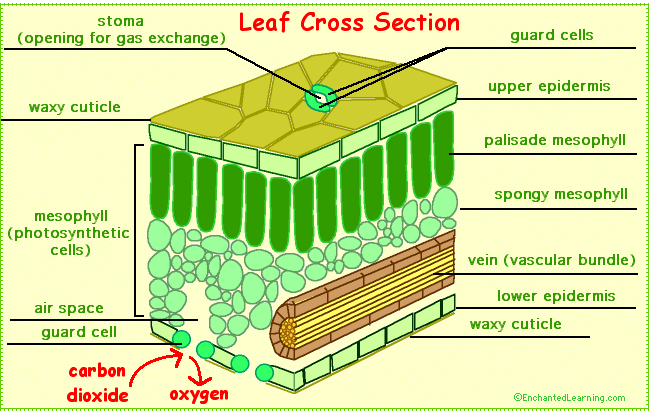
A plants leaves serve the very important task of food production. They contain chloroplasts which use the power of sunlight to turn water H2O into oxygen O2 via photosynthesis.  This process can get infinitely more complicated depending on the type of plant, but for today we will keep it simple and just do the process and structure of an average leafy plant.  The leaves also transpire i.e. let gases and even water escape via leaves. 


Now this diagram shows the structure for an average leaf, but each of the above sections can be expanded or condensed based on the plants environment.  Cacti have modified leaves in the form of spines, I assure you these really are their form of leaves.  They have condensed the leaf volume down drastically because they live in an volatile sun and heat environment.  They also have developed a very thick waxy cuticle to literally seal in water and prevent transpiration. 

So compare the succulents with their complete opposite, plants on the jungle floor, like the Swiss cheese plant (Monstera deliciosa).  This is a plant with giant dark green leaves.  So why have huge wide leaves?  Well this plant normally lives on the jungle floor where only traces on sunlight sneak through the dense canopy.  The most efficient way to get enough sunlight is to cover as much area as possible.  Jungles are also subject to high rain volume and humidity, so large leaves allow excessive water to transpire, but humidity doesn't allow the plant to become dehydrated.

For the last plant today, lets look at one of the worlds most popular plants, a rose.  Roses typically like moderate sun and light watering.  They are notoriously hardy and easy to maintain.  Their leaves are smaller and moderate in amount.  This makes sense, have leaves that are a conservative size because they happily exist in open sun areas.  They do not need to be ultraconservative to survive extreme temperatures so the conventional leaf shape is still acceptable.  They have a drier leaf because they do live in direct sunlight and lower humidity areas.  they can't afford to let too much water transpire.

I hope taking a look at three types of leaves inspires you to take a closer look at plants and life on this planet in general.  Nature designed everything with a purpose.  Use your inquisitive brain and take a deeper look and ask why.

That's it for now,
Cass

Tuesday, May 1, 2012

The Last Unicorn

Trying to get back into my science mind set lately, really looking forward to some great opportunities I have coming up in my life.  My goal has been and continues to be conservation of our planet and the plants and animals that inhabit it.  My mind often wanders on how best to accomplish my mission, thus far my best answer has been to continue on my path.  So enough with the life goal talk, lets get to the animals! 

I often joke how cool it would be to have a unicorn or Pegasus but few people realize that there are animals that have been suspected of being mythical in earlier times.  The Oryx has been accused of being a unicorn by several civilizations and high authority figures.  Aristotle and Pliny the Elder both thought the Oryx was the unicorn prototype.   The unicorn belief was likely perpetuated because a Oryx's horn is made of bone, therefore when a Oryx looses one via injury it will not grow back.  Their profile also hides one horn behind the other.  This would likely lead to several unicorn "sightings". 

The Oryx resembles an antelope or large deer.  It is very large (400 lbs), white with dark markings around eyes and on shoulders, and their most prominent feature are their two long horns.  There are a few types including the Arabian Oryx and Scimitar Oryx.  They prefer grassy steppes or semi-desserts.  They used to roam over Eastern Africa, and North American, they are considered extinct in the wild.  Zoos across the country have untied to get a large breeding program together and they are making a comeback. 

The Oryx is extremely good at adapting their body for hot temperatures.  They can reduce the rate of evaporation from their body to conserve water.  They can modify their body to 46.5 degrees Celsius before perspiration, while also being able to lower their temperature to 36 degrees Celsius at night.  They have a network of very fine blood vessels that travel from heart to the brain that pass through the nasal passages.  This allows blood to cooled before it hits the brain.  Due to their special kidneys which can stop urination, an Oryx can survive 9-20 months without water.  They can get their water requirement met by eating water rich plants. 

Hope you enjoyed learning a little more about a real life unicorn, the Oryx. 
That's it for now,
Cass

Thursday, April 12, 2012

Nudibranch (Nothing to do with Naked Chicks....)

I want to keep the unusual animal streak going, but change it up by going to the ocean for our next creature.  The Nudibranch resembles a neon colored slug and can either be smooth or have lots of equally colorful tentacles.  Nudibranch's have undergone detorsion, where their mouth and anus for a long continuous tube.  Torsion is the process that shelled gastropods go through to rotate their mantle and shell 180 degrees to bring it directly above their head.  Due to going through detorsion, Nudibranch's are bilaterally symmetrical.  They have very simple eyes which are typically limited to sensing light and dark.  They breathe through a naked grill that forms branchial plumes in a rosette in their back, where the name Nudibranch likely originated from. 

They are hermaphoditic (containing both sexes) but cannot fertilize themselves.  Hermophoditicism is a common trait in sea animals to increase likely hood of finding a mate.  Think to a Nudibranch every other Nudibranch you meet is a potential partner, instead of being limited to one sex or the other. 

So the big question remains, why did Nudibranch's develop such bright colors?  well it seems Nudibranch's took two alternative approaches, one was to blend in the other to stand out.  Some Nudibranch developed colors and appendages to mimic plants around them, an extreme camouflage.  While other Nudibranch took the opposite approach and developed bright colors to stand out and warn predators that they are poisonous or distasteful.  Some Nudibranch feed on hydroids then store the hydroids' nematocysts (stinging cells), they can travel down their body with out harming the Nudibranch.  They likely do this with a large vacuole surrounding the nematocyst.  There are some Nudibranch's that can produce toxins on their own without dietary aid, there is even a type of Nudibranch that can excrete acid out their skin. 

To sum up, the Nudibranch is more than a colorful sea slug, it is a highly specialized creature showing every color of the rainbow.  That's it for now,
Cass