Thursday, May 24, 2012

More Than a Leaf

Many new and exciting things have been happening in my life, currently the very best one is I have been given an opportunity to study and learn from an amazing person all about plants!  I have only been up to the ranch twice but I have learned so much and feel truly inspired.  So in honor of the wonderful world of plants I want to write about a subject I taught about in my good friend Gilly's 4th grade class, leaves!
I went to Gilly's class to discuss biomimicry and more importantly taking a closer look at the world.  I finished my talk by giving every student in the class a piece of wheat grass and asking why they thought it was designed the way it was.  They had some great and inventive answers, just a small reinder about how we loose the power of imagination and thinking outside the box as we age.  But back to my topic, leaves are a great example of how form follows function.

A plants leaves serve the very important task of food production. They contain chloroplasts which use the power of sunlight to turn water H2O into oxygen O2 via photosynthesis.  This process can get infinitely more complicated depending on the type of plant, but for today we will keep it simple and just do the process and structure of an average leafy plant.  The leaves also transpire i.e. let gases and even water escape via leaves. 
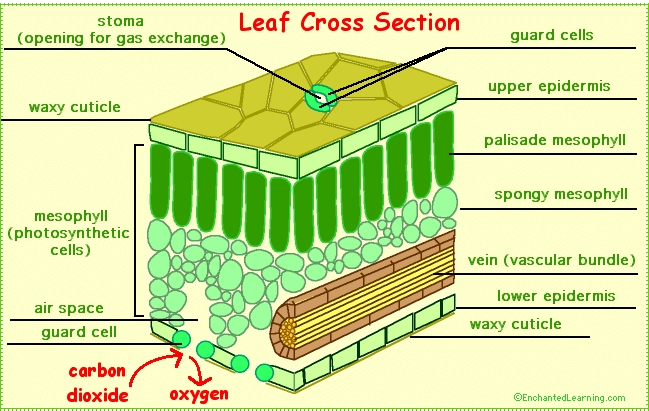

Now this diagram shows the structure for an average leaf, but each of the above sections can be expanded or condensed based on the plants environment.  Cacti have modified leaves in the form of spines, I assure you these really are their form of leaves.  They have condensed the leaf volume down drastically because they live in an volatile sun and heat environment.  They also have developed a very thick waxy cuticle to literally seal in water and prevent transpiration. 

So compare the succulents with their complete opposite, plants on the jungle floor, like the Swiss cheese plant (Monstera deliciosa).  This is a plant with giant dark green leaves.  So why have huge wide leaves?  Well this plant normally lives on the jungle floor where only traces on sunlight sneak through the dense canopy.  The most efficient way to get enough sunlight is to cover as much area as possible.  Jungles are also subject to high rain volume and humidity, so large leaves allow excessive water to transpire, but humidity doesn't allow the plant to become dehydrated.

For the last plant today, lets look at one of the worlds most popular plants, a rose.  Roses typically like moderate sun and light watering.  They are notoriously hardy and easy to maintain.  Their leaves are smaller and moderate in amount.  This makes sense, have leaves that are a conservative size because they happily exist in open sun areas.  They do not need to be ultraconservative to survive extreme temperatures so the conventional leaf shape is still acceptable.  They have a drier leaf because they do live in direct sunlight and lower humidity areas.  they can't afford to let too much water transpire.

I hope taking a look at three types of leaves inspires you to take a closer look at plants and life on this planet in general.  Nature designed everything with a purpose.  Use your inquisitive brain and take a deeper look and ask why.

That's it for now,
Cass

Tuesday, May 1, 2012

The Last Unicorn

Trying to get back into my science mind set lately, really looking forward to some great opportunities I have coming up in my life.  My goal has been and continues to be conservation of our planet and the plants and animals that inhabit it.  My mind often wanders on how best to accomplish my mission, thus far my best answer has been to continue on my path.  So enough with the life goal talk, lets get to the animals! 

I often joke how cool it would be to have a unicorn or Pegasus but few people realize that there are animals that have been suspected of being mythical in earlier times.  The Oryx has been accused of being a unicorn by several civilizations and high authority figures.  Aristotle and Pliny the Elder both thought the Oryx was the unicorn prototype.   The unicorn belief was likely perpetuated because a Oryx's horn is made of bone, therefore when a Oryx looses one via injury it will not grow back.  Their profile also hides one horn behind the other.  This would likely lead to several unicorn "sightings". 

The Oryx resembles an antelope or large deer.  It is very large (400 lbs), white with dark markings around eyes and on shoulders, and their most prominent feature are their two long horns.  There are a few types including the Arabian Oryx and Scimitar Oryx.  They prefer grassy steppes or semi-desserts.  They used to roam over Eastern Africa, and North American, they are considered extinct in the wild.  Zoos across the country have untied to get a large breeding program together and they are making a comeback. 

The Oryx is extremely good at adapting their body for hot temperatures.  They can reduce the rate of evaporation from their body to conserve water.  They can modify their body to 46.5 degrees Celsius before perspiration, while also being able to lower their temperature to 36 degrees Celsius at night.  They have a network of very fine blood vessels that travel from heart to the brain that pass through the nasal passages.  This allows blood to cooled before it hits the brain.  Due to their special kidneys which can stop urination, an Oryx can survive 9-20 months without water.  They can get their water requirement met by eating water rich plants. 

Hope you enjoyed learning a little more about a real life unicorn, the Oryx. 
That's it for now,
Cass

Thursday, April 12, 2012

Nudibranch (Nothing to do with Naked Chicks....)

I want to keep the unusual animal streak going, but change it up by going to the ocean for our next creature.  The Nudibranch resembles a neon colored slug and can either be smooth or have lots of equally colorful tentacles.  Nudibranch's have undergone detorsion, where their mouth and anus for a long continuous tube.  Torsion is the process that shelled gastropods go through to rotate their mantle and shell 180 degrees to bring it directly above their head.  Due to going through detorsion, Nudibranch's are bilaterally symmetrical.  They have very simple eyes which are typically limited to sensing light and dark.  They breathe through a naked grill that forms branchial plumes in a rosette in their back, where the name Nudibranch likely originated from. 

They are hermaphoditic (containing both sexes) but cannot fertilize themselves.  Hermophoditicism is a common trait in sea animals to increase likely hood of finding a mate.  Think to a Nudibranch every other Nudibranch you meet is a potential partner, instead of being limited to one sex or the other. 

So the big question remains, why did Nudibranch's develop such bright colors?  well it seems Nudibranch's took two alternative approaches, one was to blend in the other to stand out.  Some Nudibranch developed colors and appendages to mimic plants around them, an extreme camouflage.  While other Nudibranch took the opposite approach and developed bright colors to stand out and warn predators that they are poisonous or distasteful.  Some Nudibranch feed on hydroids then store the hydroids' nematocysts (stinging cells), they can travel down their body with out harming the Nudibranch.  They likely do this with a large vacuole surrounding the nematocyst.  There are some Nudibranch's that can produce toxins on their own without dietary aid, there is even a type of Nudibranch that can excrete acid out their skin. 

To sum up, the Nudibranch is more than a colorful sea slug, it is a highly specialized creature showing every color of the rainbow.  That's it for now,
Cass

Tuesday, March 27, 2012

Ta-Da! The Tarsier...

Tarsier's are small primates with gigantic eyes.  I find them absolutely adorable, but I'm a sucker for big pretty eyes and soft critters.  They resemble a pygmy marmoset crossed with a bat and have some truly ginormous eyes.  They currently live in Southeast Asia but were once far more widespread.  Tarsier's are the only carnivorous primate.  They like to prey on insects,lizards, and especially birds.  They are mainly nocturnal but you can find some awake in the day but acting far more lethargic.

Might as well start with the Tarsier's most defining feature their eyes.  Each eyeball can stretch 16 mm in diameter, considering this animal is barely larger than your hand and with a head 20 cm long, eyes that large is quite a feat. Their eyes are actually larger than their brain, they also lack the ability to reflect light.Their eyes and how they connect to their brain gives good reasoning that tarsier is actually an older species of primate.  Our thalamus receives visual information and is connected to our eyes directly, a tarsier has a very different arrangement than all other primates.

Tarsier's got their name because they have very elongated tarsus bones in their feet.  Their fingers are also elongated and have nails.  The third digit on their hands is almost as long as their entire forearm and contains a single long claw.  Their strange limbs make them adept for tree living.  Tarsiers are known to leap and catch birds mind flight and jump to another tree.

Tarsiers have never been able to sustain a population in captivity.  Their is only a few sanctuaries that have been established successfully.  This is a great example of an animal who has been greatly affected by habitat loss.  The only way for this unusual creature to survive is by having large sections of forest to roam and re-populate.

That's it for now,
Cass

PS you have to admit they have cute moments....

Friday, March 16, 2012

What in the World? A Pangolin...

So continuing with my month of exotic animal posts, today is all about the only scaled mammal, the Pangolin.  Many people are confused by this animal because it looks like a reptile crossed with a weasel and a dash of armadillo thrown in.  Pangolin's live mainly in Africa and some parts of India and Southern Asia.  It is a mammal the only kind with keratin scales covering its body.  When pangolin's are born the scales are soft and harden.  Keratin is the same material in our hair, nails, and even in rhino horns. 

Pangolin's has long claws and either live in trees or large underground boroughs.  Their front claws are so long they cannot walk flat footed and instead walk with their front feet curled under.  Pangolin's have no teeth instead they tear apart trees or termite mounds and use their long tongue to slurp out insects and grubs.  The tongues of Pangolin's are extra long and appear longer because they are unattached to their hyroid bone.  So their tongues extend all the way into their abdominal cavity.  When pangolin's are sleeping or scared they can curl into a ball like an armadillo.  They are nocturnal animals so they are most active at night.  The pangolin has a prehensile tail and can hang from it, often to get tasty insects.

Scientists have a hard time classifying exactly which animals are related to Pangolin's, currently they are listed in the order Pholidata with lots of now extinct animals.  There is a lot of debate if they actually belong there, a large number of scientists believe they should be grouped sloths and anteaters in the Xenarthra order.  The debate on where the Pangolin's should be classified tells me they are a very unique creature who has convergently evolved similar characteristics as several other species.  I think all can agree this is a special creature with lots of special attributes.

That's all for now,
Cass

Monday, February 27, 2012

The Animal That Smells Like a Movie Theater....

I've mostly written about animals that are fairly common and well known, but I think it is time to branch out into some more exotic and unknown animals.  So today kicks off a month of unusual animals posts.  First off is an animal that I first saw at the San Diego Zoo.  My dad was an analytical chemist for CREST, the science portion of the zoo.  It was his job to pick me up from school every Monday when my mom was too busy.  This gave me the luxury of going back to work with him at the zoo every Monday.  As you can imagine I got lots of behind the scenes tours and saw far more of the zoo than the average person.  One of my favorite animals that wasn't a main attraction was the Binturong. 

When you hear the name Binturong, the thought springs to mind is likely what the heck kind of animal is that?  It is a medium sized brown critter that looks like a fox, raccoon, cat, and maybe a little dog all mixed together  It is actually part of the Viverridae family which includes civets and genets, which resemble cats crossed with weasels.  The most striking feature of this animal has nothing to do with it's looks but actually it's smell.  A Binturong smells like fresh buttered popcorn!  Binturongs use their scent markings to signal when they are ready to mate.  Since they live solitarily, scent markings are needed to bring animals together for those romantic times of year.

Binturongs are one of the few animals that can use delayed implantation or embryonic diapause.  This is when a female can mate and delay the embryo from implanting until conditions are better.  They cannot delay implantation for long term, but a few weeks can mean the difference between starving and surviving to a Binturong.

Binturongs live in the trees and have hands evolved to live in a tree lifestyle.  Their paws have claws that are perfect grapsers on tree limbs.
Hope you enjoyed being introduced to a fun creature, next weeks post will be about another unusual animal.
Cass

Tuesday, February 14, 2012

A Puppy For Valentine's Day?

As much as I would love a puppy for Valentine's Day, my living situation doesn't allow for that right now.  So I'm going to do the next best thing, discuss their relatives.  Today we will get back to regular biomimicry posts with Wolves.  Wolf packs consist of an alpha mated pair, their offspring, and some occasional stray juveniles.  In low population areas the mated pair can be monogamous for life.  making it one of the few animal species that exhibit monogamy.

Wolves have five toes on front paws and four toes on rear paws.  Their legs are built with elbows pointed in and feet pointed out.  This is for optimal running and gripping on difficult terrain, while also allowing them to leap and grasp prey.  In cold climates wolves can the flow of blood close to their skin to conserve body heat.  This keeps warm blood close to internal organs and away form outside of their body where heat is loss.  Keeping warm is one of the body's most difficult tasks and burns lots of calories.  By cutting down on heat loss the wolf doesn't need to eat massive amounts of food.  It is the same reason why people in freezing temperatures have to eat more calories per day to maintain body weight. Their foot pads are regulated independently from the rest of their body.  their temperature is kept right about tissue freezing point.

Wolves howl to assemble the pack, alert the pack of danger, or locate each other during storms.  Wolves have superior hearing being able to hear up to 26kHz which is superior to all other members of the canine family.  Their sense of smell is considerably less powerful that many domestic dogs.  Their eyesight is also less powerful than many domestic dog breeds but they have better night vision.  Wolves will set up ambushes, with a single decoy wolf running ahead while the rest of the pack attacks from behind.  Wolves will eat the internal organs first, followed by the muscles second.  Wolves prefer larger prey but will eat fowls during mating season and even snakes and lizards if made available. 

Hope everybody has a Valentines  Day is filled with love and if you don't have that special someone kiss your puppy or cat, I know I have many years and never came away disappointed.

That's it for now,
Cass