So I know typically I post about animals and biomimicry, but today I want to share another passion of mine, clean eating. This is eating food which is as close to possible as its' natural state. So no processed food. Obesity has become rampant and people without weight problems have so many ailments that are a direct link to eating heavily altered and processed foods.
Now I'm about to put forth some controversial ideas out there. When I tell people I'm against taking antibiotics, or sleep aids, anything for an extended period of time I get a lot of funny looks. I mean I am a biologist right? Don't biologist come up with new cures and solve the world's problems? We do but I believe science is trying to fix too many surface problems. If we didn't focus so much time on the next weight loss drug, or headache pills, and all of the minor problems, more attention could be put into solving cancer, AIDS, very big not self inflicted issues.
Let me ask some of you out there if you have any of these problems, minor but daily headaches, joint pain, acid reflux, anxiety, sleep problems, overweight? These all can be fixed or vastly improved through clean eating. I know because I suffered from daily headaches that got to be debilitating, inability to sleep, no energy, and overweight. These all have been fixed in less than a month. I've lost 8lbs, not a single headache, dreaming for the first time in months, and feeling more alive than ever.
How does one eat clean? Very easy avoid any processed food and eat as much natural food as possible. Basically anything that comes in a package is bad news, sodas and many juices are bad, white sugar and flour are bad, if it doesn't rot in less than a week it has been altered heavily and is full of preservatives. It is nearly impossible to eat 100% clean and I don't. But the better you eat the more your body will restore to its' original blueprint of perfection. You may not be stick thin but you will be a healthy weight, you may not sleep for 10 hrs but you will sleep as much as your body needs. It works for everything. Eating non-processed also means cooking a lot and not eating out. I cook daily and make extra to take on my lunches. I eat a huge variety of meat, fruit, veggies, nuts, whole grains, because I get bored with food easily.
I also like to pair the clean eating with moderate exercise. The more you are active the better your circulation, the more energy you get, the more calories you burn. It can be nearly any type of activity, I ride my horses and walk, so nothing extreme. It will only enhance the clean eating. That's all for now,
Cass
Wednesday, February 8, 2012
Monday, January 23, 2012
Turtle Power!
Turtles are one of the oldest animals dating back to 215 million years ago, this makes turtles older than snakes, lizards and crocodiles. Turtles are divided into two groups by how they retract their neck into shells. One group compresses their spine while the other puts their head to the side. Turtles like all reptiles lay eggs. In some species of turtles the temperature that the egg develops determines in the baby will be male or female. Higher temperature causes females, and lower temperatures cause males. This is a phenomenon known as Temperature-Dependent Sex Determination. The exact reason why turtles and some reptiles and birds have TSD is unknown but theorized that it is advantageous to have females earlier in the season so they have more time to grow and be ready to mate sooner. But there is little evidence showing turtles actively choose their offspring's sex.
Sea turtles have a special gland in the corner of their eye to get rid of excess salt. They live in sea water and eat jellyfish and other prey with high salt concentrations. Now I think of this special salt gland and think of how can it be used in humans. Well kidney failure patients have a horrible time dealing with their salt regulation, if the same chemicals and processes in the sea turtle eye gland could be replicated it could help many people currently undergoing dialysis.
The Alligator Snapping Turtle is built like a tank, with a huge head and heavily plated back with three rows. Algae will often grow on their shells allowing them to fully blend in underwater. Inside the turtles mouth is a small appendage that looks like a small worm to draw fish in, once there their powerful jaws snap down!
Well hopefully I have taught you a little more than what you already knew thanks to teenage mutant ninja turtles... That's all for now,
Cass
Sea turtles have a special gland in the corner of their eye to get rid of excess salt. They live in sea water and eat jellyfish and other prey with high salt concentrations. Now I think of this special salt gland and think of how can it be used in humans. Well kidney failure patients have a horrible time dealing with their salt regulation, if the same chemicals and processes in the sea turtle eye gland could be replicated it could help many people currently undergoing dialysis.
The Alligator Snapping Turtle is built like a tank, with a huge head and heavily plated back with three rows. Algae will often grow on their shells allowing them to fully blend in underwater. Inside the turtles mouth is a small appendage that looks like a small worm to draw fish in, once there their powerful jaws snap down!
Well hopefully I have taught you a little more than what you already knew thanks to teenage mutant ninja turtles... That's all for now,
Cass
Wednesday, January 11, 2012
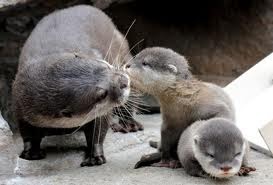
Outrageous Otters
In honor of some special people in my life who love otters, today's blog post is for them (yes you Mow Wow). Otters are related to weasels, badgers, and wolverines, quite a list of tough relatives. There are many types of otter including but not limited to, North American river otter, Sea otter, Eurasian otter, and Giant otter. Most view otters as adorable critters who frolic in the water... Otters are actually incredibly tough little guys. (click on the video to watch them take on a crocodile, sorry I couldn't find this minus the ads, but the best part starts at 1:00 minute)
http://www.youtube.com/watch?v=ArhWJts2sg8
Now Sea otters do not have an insulating layer of blubber like other ocean mammals (seals and whales), instead they have very dense fur that traps in air. They will bob to the surface and blow into their fur to keep it warm. An otters coat is very dense at 26,000 to 165,000 strands per square centimeter of skin, compare that to humans with 3175 strands per centimeter on their heads.

The Giant otter lives in South America along the Amazon and Panthal rivers. They live in large colonies lead by a dominant breeding pair. This otter species is exclusively diurnal, or only active during the day. Being diurnal indicates that otters have amazing eyesight, in and out of water, and shows they are a sight predator. Otters on the whole are extremely vocal, with the Giant otter being the most vocal. Their chirps and barks mean anything from greetings to warnings. Otters are opportunistic eaters devouring a wide variety of food including fish, crabs, snakes, and caimen babies. One commonly eaten fish by Giant otters is even piranha, now that's a tough guy!
Hope you all enjoyed the break from my pet posts, and learned a little more about one of the toughest and cutest critters out there.
Cass
http://www.youtube.com/watch?v=ArhWJts2sg8
Now Sea otters do not have an insulating layer of blubber like other ocean mammals (seals and whales), instead they have very dense fur that traps in air. They will bob to the surface and blow into their fur to keep it warm. An otters coat is very dense at 26,000 to 165,000 strands per square centimeter of skin, compare that to humans with 3175 strands per centimeter on their heads.

The Giant otter lives in South America along the Amazon and Panthal rivers. They live in large colonies lead by a dominant breeding pair. This otter species is exclusively diurnal, or only active during the day. Being diurnal indicates that otters have amazing eyesight, in and out of water, and shows they are a sight predator. Otters on the whole are extremely vocal, with the Giant otter being the most vocal. Their chirps and barks mean anything from greetings to warnings. Otters are opportunistic eaters devouring a wide variety of food including fish, crabs, snakes, and caimen babies. One commonly eaten fish by Giant otters is even piranha, now that's a tough guy!
Hope you all enjoyed the break from my pet posts, and learned a little more about one of the toughest and cutest critters out there.
Cass
Tuesday, January 3, 2012
Being a Crazy Cat Lady Doesn't Sound Too Bad
I know lately you have been inundated with my posts about my pets. First my horses, then the giant bunny, well I'm not quite finished... I introduce you to Fluff! Well technically her name is Penelope, but my dad started calling her "The Fluff" and well, it stuck. Fluff is a shelter kitty whom I got on my 18th birthday. She is my constant companion and basically my child. So how about some fun facts about Fluff and other cats. Please note this blog contains lots of genetics terms and discussions...
Most know cats come in a variety of colors, calico being a tri-colored cat (Fluff happens to be a calico). A little known fact is calico coloring is almost exclusively reserved for female cats. Wait, how is this unusual coloration created, and why do only females get it? Both questions can be answered by a scientific principle, X inactivation. Lets break this down to basics, a male has an X and a Y chromosome, where as females have two X's. The X chromosome is far larger than a Y and contains far more information, including the coding for hair color. During the developmental process one X chromosome is dominant over the other therefore the other X is inactivated, but not for long. The two X's take turns. Now if the X chromosomes code for different colors, they will display the calico pattern as the X's take turns switching on and off. Depending on the frequency and duration that each X is on/off you get different size patches or even patches that appear interwoven. This either gives you a brindle colored coat (like Fluff) or a patchwork coat more like a quilt.
![]() |
| Fluff and her unique face |
Most know cats come in a variety of colors, calico being a tri-colored cat (Fluff happens to be a calico). A little known fact is calico coloring is almost exclusively reserved for female cats. Wait, how is this unusual coloration created, and why do only females get it? Both questions can be answered by a scientific principle, X inactivation. Lets break this down to basics, a male has an X and a Y chromosome, where as females have two X's. The X chromosome is far larger than a Y and contains far more information, including the coding for hair color. During the developmental process one X chromosome is dominant over the other therefore the other X is inactivated, but not for long. The two X's take turns. Now if the X chromosomes code for different colors, they will display the calico pattern as the X's take turns switching on and off. Depending on the frequency and duration that each X is on/off you get different size patches or even patches that appear interwoven. This either gives you a brindle colored coat (like Fluff) or a patchwork coat more like a quilt.
Now a few people may argue that thy have seem male calico cats. They are very likely chimeras, or have two genotypes. The possible types would be XX XX, XY XX, or XY XY. This can also create a calico coat pattern through a somewhat similar process except with two completely different sets of chromosomes. There are a few other genetic disorders that can also lead to calico males but mainly, calico cats are female.
![]() |
| Polydactyl Cat |
Cats can have extra toes, this is called Polydactylism. It can give cats six or even seven claws on each paw. A normal cat has five toes up front and four on hind feet. This is caused by a congenital abnormality, basically it is inherited. It is caused by an autosomal dominant gene in cats. So the polydactyl factor is located on a chromosome that isn't X or Y and is dominant so you only need to get the one copy to get it.
Whew, did I overload your brain with all that genetic jargon? On a lighter note it has been drawn to my attention that I could be considered a crazy animal lady. My best response is I am 100% one, I love my animals and given enough room and resources would gladly have a zoo or animal center. My animals will never maliciously hurt me if I didn't provoke it, and love me unconditionally. Thus far there is no human who can compete, myself included. That's all for now,
Cass
![]() |
| Sleeping Fluff |
Thursday, December 29, 2011
New Year New Bunny
So New Years is all about having a great party and welcoming the new year with hopes it will be better than the last. Well I know 2012 is going to be a great year for me because I got a new bunny! Her name is Opal, and she is a blue Flemish Giant. While this isn't the largest breed of rabbit, she is a very big girl, and should grow up to be well over 20 lbs. In today's post we will talk about some science but I'm also a history fan so I'm going to change things up and talk about how giant breeds (in this case rabbits) came to America.
| Opal at 8 weeks old |
In the 1800's rabbits were raised and used for meat very commonly throughout Europe. This was mainly due to the fact that large livestock was expensive to feed, house and had slow breeding rates. Rabbits have limited need for space and very fast reproductive rates. Being an island, England consumed large amouts of rabbits, and soon turned to importing them to keep up with demand. Commonly bred rabbits were mid sized around 7 to 8 lbs. Travelers returned to England with wild tales of rabbits three times the size in Flanders. Thus around 1860 Flemish Giants were imported to England, then imported to the Americas in 1890 during a similar "rabbit boom". So now that we know how Flemish Giants got here lets get down to some science!
| Opal at 10 weeks old |
Probably the most distinguishable features of rabbits are their giant ears. Most people know their ears act like giant dishes to catch sound waves. But their ears are also one of their main temperature control (i.e. thermoregulation) devices. When looking at the rabbits ears you will see many blood vessels. If a rabbit is cold the simply need to go out into the sun or fold their ears close to their furry bodies, the ears blood vessels go through vasoconstriction or become smaller to retain heat. If a rabbit is hot they can go into the shade and fan out their ears, where their blood vessels go through vasodilation.
Cass (and Opal as the Jackalope)
Tuesday, December 20, 2011
Pony Time!
So with Christmas less than a week away, I know many little girls are hoping Santa (and their parents) will heed their desperate pleas for a pony under the tree. Well I was one of the lucky little girls who actually got their dream pony... My first pony was Phoenix (all pictures of her are in print and I don't have a scanner) and she was that ultimate little girl fantasy, a snowy white Arabian with a perfect dished face. Could have been a unicorn (and got dressed as one several times) if you put a horn on her sculpted face. I kept her till she passed away when I was 21. My second pony is Max (pictured left), another grey Arabian who originally was for my mom but ended up as my jumping pony, clearing obstacles with me that towered higher than his head. He is still going strong at 25 giving walk-trot lessons for little kids. Today I have two horses who decorate the side of my blog, Manhattan and Finally. Manhattan (Manny) is a 17.1 hand Thoroughbred (pictured below) who can jump a house. Finally is the golden child (pictured at end of blog). He is a Quarter horse who I have had since he was 2 and has the biggest heart. Now that I've shared about my ponies lets get to some science! Horses are highly evolved animals with some unique attributes. In my opinion, their feet have the most highly specialized design. A horse's hoof is actually is the anatomical equivalent of our fingernail. If you pick up a horse's hoof and look at the underside they have a triangle middle, this is the horse's frog. It is a spongy shock absorber. As a horse gallops the hard outside hoof wall strikes first then the frog extends down and outward to absorb much of the shock. Now I look at the frog and think wow that would be something Nike would love to use in their newest running shoe, or how about inspiration for shocks on off road vehicles?
The frog is also an amazing pump for the horse's circulatory system. As the horse puts weight onto the hoof, the hoof wall is pushed outwards and the frog compressed, driving blood out of the frog. When weight is removed from the hoof, the release of pressure pulls blood back down into the foot again. This creates a blood pumping system up and down the horses legs. Horses rarely lay down, you mostly see young horses or older horses taking extended naps. Horse are unable to spend a long time laying down because their massive body weight will actually crush their internal organs. So horses spend most of their time standing up. They have a special locking feature in their knees to help them sleep standing up. So having great leg circulation becomes even more important.
I could go on and on about horses but for today that is all you get! Hope everyone has a happy holiday season with their loved ones. Cass
P.S. including a horse treat recipe just in case you're like me and want to give your equine friends a holiday treat, just add raisins to make it human friendly.
Oat Molasses Cookies
2 Cups Dry Oatmeal
1/2 Cup grated Carrots
3 Tablespoons Molasses
1/2 Cup Brown Sugar
Combine all ingredients. Add enough water to make a soft dough. Stir
well. Form cookies. Bake 350 for 8 minutes or until golden brown.
Thursday, December 8, 2011
Reindeer Games
Well it is the beginning of December so time for a holiday post. Today's featured animal will be the Reindeer also known as the Caribou. I thought it would be fun to outline some points that would make Reindeer a great animal to pull Santa's sleigh. They live in both Tundra and Borreal Forrest areas, both of which are very cold. Reindeer fur has an undercoat and topcoat to help combat the extreme cold. The undercoat is dense and wooley, while the top coat is longer with hollow air-filled hairs.
Only the most impressive animal will do for Santa, and a reindeer's antlers certainly look fancy. Both the males and females grow antlers but the males grow them noticeably larger. The age of the deer determines when their antlers fall off. The older males loose them in December the younger males loose them in spring. Reindeer antlers are the largest compared to their body size.
Something you may not realize about Reindeer is they have a very special nose. No, it doesn't glow red like Rudolf's. They have nasal turbine bones that increase the surface area dramatically. This allows incoming air to be warmed by the deer's body heat before being transported to the lungs. The moisture is also captured from the wet cold air before the warmed air is expired. The moisture can be used to moisten dry air or even be reabsorbed back into the body via capillaries.
Why were Reindeer chosen to pull Santa's sleigh? Well, I think it is because they are the only mammal to see ultraviolet light! They can see wavelengths at around 320 nm much better than humans who tap out at 400 nm. This is likely because Reindeer live in the Arctic where the world is often covered in snow and relatively monotoned. Seeing ultraviolet helps certain objects stand out.
Happy Holidays to everyone,
Cass
Only the most impressive animal will do for Santa, and a reindeer's antlers certainly look fancy. Both the males and females grow antlers but the males grow them noticeably larger. The age of the deer determines when their antlers fall off. The older males loose them in December the younger males loose them in spring. Reindeer antlers are the largest compared to their body size.
Something you may not realize about Reindeer is they have a very special nose. No, it doesn't glow red like Rudolf's. They have nasal turbine bones that increase the surface area dramatically. This allows incoming air to be warmed by the deer's body heat before being transported to the lungs. The moisture is also captured from the wet cold air before the warmed air is expired. The moisture can be used to moisten dry air or even be reabsorbed back into the body via capillaries.
Why were Reindeer chosen to pull Santa's sleigh? Well, I think it is because they are the only mammal to see ultraviolet light! They can see wavelengths at around 320 nm much better than humans who tap out at 400 nm. This is likely because Reindeer live in the Arctic where the world is often covered in snow and relatively monotoned. Seeing ultraviolet helps certain objects stand out.
Happy Holidays to everyone,
Cass
Subscribe to:
Posts (Atom)